
Home › Egg collection in IVF: what happens on the ultrasound screen
Egg collection in IVF: what happens on the ultrasound screen
Egg collection in IVF, also called egg retrieval or oocyte pick-up, is a short procedure done under light anaesthesia. A fine needle, guided by ultrasound, passes through the vaginal wall into each follicle of the ovaries. The fluid is drained and the embryologist finds the eggs in it. There are no cuts or stitches on the tummy.
Watch the video
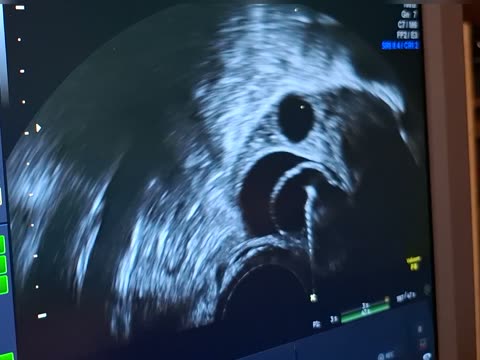
This seven-minute video by our consultant shows a real ultrasound screen recorded during an egg collection, explained step by step in simple English. At the end, our consultant speaks in Konkani. The video will be available on our YouTube channel from April 2027. Until then, the guide on this page is the same explanation, written out. Its chapters:
- 0:00 What egg collection is
- 0:35 How it is done under ultrasound
- 1:11 Light anaesthesia
- 1:44 What the dark circles (follicles) are
- 2:21 Draining each follicle
- 2:52 The fluid goes to the embryology lab
- 3:22 Moving to the other ovary
- 3:53 Not every follicle gives an egg
- 4:25 How long it takes and the rest afterwards
- 4:59 What happens to the eggs next
- 6:13 A word from our consultant (in Konkani)
What is egg collection in IVF?
The video opens on a real ultrasound screen, recorded during an egg collection. In IVF, this step is also called oocyte pick-up. During the hormone injections of an IVF cycle, several eggs grow inside the ovaries. Egg collection is how those eggs are gently taken out, so that they can meet the sperm in the laboratory.
How the egg retrieval procedure is done
The procedure is done through the vagina, under ultrasound guidance. A slim ultrasound probe is placed inside, and a fine needle is passed along a guide attached to it. On the screen, the needle shows up as a bright, straight line coming in from the side. The guide keeps the needle on a planned path, so the doctor can follow it clearly on the screen.
Is egg collection painful?
Before the procedure begins, the woman is given light anaesthesia, so that she is relaxed during it. The anaesthesia team watches her closely throughout. Because the anaesthesia is light, she usually wakes up soon after the procedure is over.
There are no cuts or stitches on the tummy, because everything is done from inside, through the vaginal wall. Some mild cramping or a little spotting can happen afterwards, and the team explains what to expect. Pain that keeps getting worse, fever or heavy bleeding is not normal, so ring us. Tummy swelling or breathlessness in the days after can be a sign of OHSS; our IVF page explains it.
What the dark circles on the screen are
The dark, round circles on the screen are follicles. A follicle is a small sac filled with fluid, and it grows in the ovary during the injections. Each follicle may hold one egg. The egg itself is far too tiny to be seen on ultrasound, so the doctor drains the fluid from the follicle, and the egg comes out with it.
Oocyte pick-up: draining each follicle
In the video, you can watch the needle enter a follicle. Gentle suction draws the fluid out, and the dark circle shrinks and collapses on the screen. The needle then moves on to the next follicle, and the next, one by one. The doctor works carefully through each follicle that can be reached safely.
From the needle to the embryology lab
The fluid travels through a thin tube into a warmed test tube, which is handed straight to the embryology lab. There, the embryologist looks at the fluid under a microscope and searches for the egg. This happens while the collection is still going on, so the team knows how things are progressing.
Moving to the other ovary
Partway through the video, the view changes. Both ovaries are usually drained, so once one side is finished, the doctor moves across to the other ovary and repeats the same steps. Sometimes the probe is repositioned to bring another group of follicles into view. The same care is taken on each side.
Not every follicle gives an egg
It is important to know that not every follicle gives an egg. Some follicles contain fluid but no egg, and this is normal. The number of eggs collected varies from woman to woman, and even from one cycle to another in the same woman. The doctor explains the result to the couple after the procedure.
How long does egg collection take?
The whole egg collection usually takes about fifteen to thirty minutes. Afterwards, the woman rests in the recovery area for a while. She usually goes home the same day, with someone to accompany her, and takes it easy for the rest of the day.
What happens to the eggs next
In the laboratory, the eggs are fertilised with sperm, either by placing the eggs and sperm together, or by injecting a single sperm into each mature egg, a technique called ICSI. Over the following days, the embryologist watches how the fertilised eggs develop into embryos.
An embryo may then be placed in the womb, and embryos that are not used straight away can be frozen for a later frozen embryo transfer. Eggs can also be frozen without being fertilised; our page on egg freezing explains who that suits.
Where egg collection fits in the IVF journey
As the video ends, the scan is completed. Egg collection is one careful step in a longer journey, and every couple's journey is different. In a usual IVF cycle, the laboratory or the theatre is needed on two days: the egg collection day and the embryo transfer day. Our IVF treatment page explains the whole cycle, step by step.
Egg collection is done in our own IVF theatre, with our embryology laboratory, in Goa. The IVF cost page sets out what the IVF price covers, including the egg-collection consumables, the procedure and OT charges, and anaesthesia. Call or WhatsApp us to book a consultation.
About this guide
This guide is by the Heartbeats IVF team. It follows the video by our consultant, written out. It is for education only and is not personal medical advice: your own treatment is decided by your doctor after examining you and reading your reports.
Questions couples ask about egg collection
Is egg collection painful?
Egg collection is done under light anaesthesia, so the woman is relaxed during the procedure, and the anaesthesia team watches her throughout. Some mild cramping or a little spotting can happen afterwards, and the team explains what to expect. Pain that keeps getting worse, fever or heavy bleeding is not normal, so ring us.
How long does egg collection take?
The procedure usually takes about fifteen to thirty minutes. After a rest in the recovery area, the woman usually goes home the same day, with someone to accompany her, and takes it easy for the rest of the day.
Are egg retrieval and oocyte pick-up the same as egg collection?
Yes. Egg collection, egg retrieval and oocyte pick-up (OPU) are three names for the same step of IVF: draining the follicles in the ovaries under ultrasound guidance to collect the eggs.
Are there any cuts or stitches after egg collection?
No. The fine needle reaches the ovaries from inside, through the vaginal wall, along a guide on the ultrasound probe. There are no cuts or stitches on the tummy.
Does every follicle contain an egg?
No. Some follicles contain fluid but no egg, and this is normal. The number of eggs collected varies from woman to woman and from one cycle to another; the doctor explains the result after the procedure.
Your visit is confidential — nothing about you appears on this website or on social media.
What you read here explains fertility care in general terms and cannot replace a consultation. Decisions about your own care should be made with a doctor who knows your history and has seen you. We do not carry out or offer sex determination of any kind, which is prohibited by law in India under the PCPNDT Act.